Whole Systems Design

To solve problems we need holistic thinking.
Once we recognize that everything is made up of interactive, interdependent systems, it becomes obvious that our individual health and wellbeing is closely tied to the health and wellbeing of both our society and the natural environment. To ignore this is to distort social priorities and investment decisions. Designing solutions to complex problems requires us to adopt a holistic (whole-systems) approach, one that recognizes all relevant factors. Sustainability means being environmentally, economically, technologically, and socially viable — which means it will be possible to design sustainable solutions only after we have defined these critical boundary conditions.

Managing climate overshoot: a risk-based strategy for climate stabilisation
Global warming is accelerating, yet current climate strategies centred on emissions reduction and carbon removal are unlikely to prevent temperatures from crossing dangerous tipping points. Although essential, these approaches operate too slowly to counter near-term warming driven by Earth’s growing energy imbalance, weakening carbon sinks, and amplifying climate feedbacks. This mismatch reflects systemic shortcomings in climate risk assessment that underestimate nonlinear risks and the escalating costs of delay.
We argue that climate stabilisation should be treated as a risk-management challenge rather than an incremental policy process. This requires explicit comparison of intervention risks with those of continued warming. We outline a comparative risk–risk framework that integrates mitigation, carbon removal, and cooling interventions, and suggests that a viable strategy may require combining rapid decarbonisation and expanded carbon removal with carefully governed cooling interventions to limit near-term warming. Without aligning response timelines with accelerating climate threats, the likelihood of irreversible Earth-system disruption will continue to grow.
Read companion piece: Managing the Risks of Missing International Climate Targets
Spaceship Earth Mission Assurance
We feel safe taking plane trips because we know that airplanes are designed and maintained to ensure maximum safety. If our children are to have lives worth living, we need to apply the methods and standards used in the aerospace industry to the problem of preserving a safe environment and ensuring a safe future.
Andrew Wilford explains in this engaging video talk . . .
Viability: A Priority Criterion for the Mitigation of Climate Change and Other Complex Socio-Ecological Issues
This paper makes two interlinked proposals for developing better — and more credible — tools for modeling critical global issues and identifying and managing threats. First, proven risk management methods from other fields can be usefully applied to the assessment and mitigation of large, complex socioecological problems. Second, using viability as the priority criterion for the design of our models will not only highlight systemic threats, but also help us develop constructive interventions.
A Realistic (Holistic) Approach to Climate Mitigation
This article examines the Paris Climate Conference (COP) 21 agreement on climate mitigation; explains why current efforts are based on false assumptions and likely to fail; argues that holistic, integrative methods are needed to avoid disaster; and uses these methods to develop a three-track strategy for accelerating systemic transformation.

The Ecology of Adventure Therapy: An Integral Systems Approach to Therapeutic Change
Adventure Therapy (AT) has been rightly criticized for not recognizing the ecological paradigm of therapy conducted in wild nature. By including principles from integral systems theory, we offer adventure therapists a map, allowing for these seemingly disparate parts to fit together into a coherent whole. In addition, we propose that wilderness is a crucial co-facilitator in the change process. If seriously considered, these ideas pose a number of important questions for AT theory and practice.
Designing the Future: An Introduction to Rurban Design
Given the challenge of sustaining 9 billion people in a world with diminishing energy reserves, we are unlikely to do better than accept the well-tested principles that living systems convey. Doing so will have transformative implications for the design of our urban and rural environments, our economic and governance systems, and our education systems. In this light, Richard Mochelle advcoates “rurban design”. The starting point of rurban design is the water catchment area, water being the most vital element in sustaining human life.
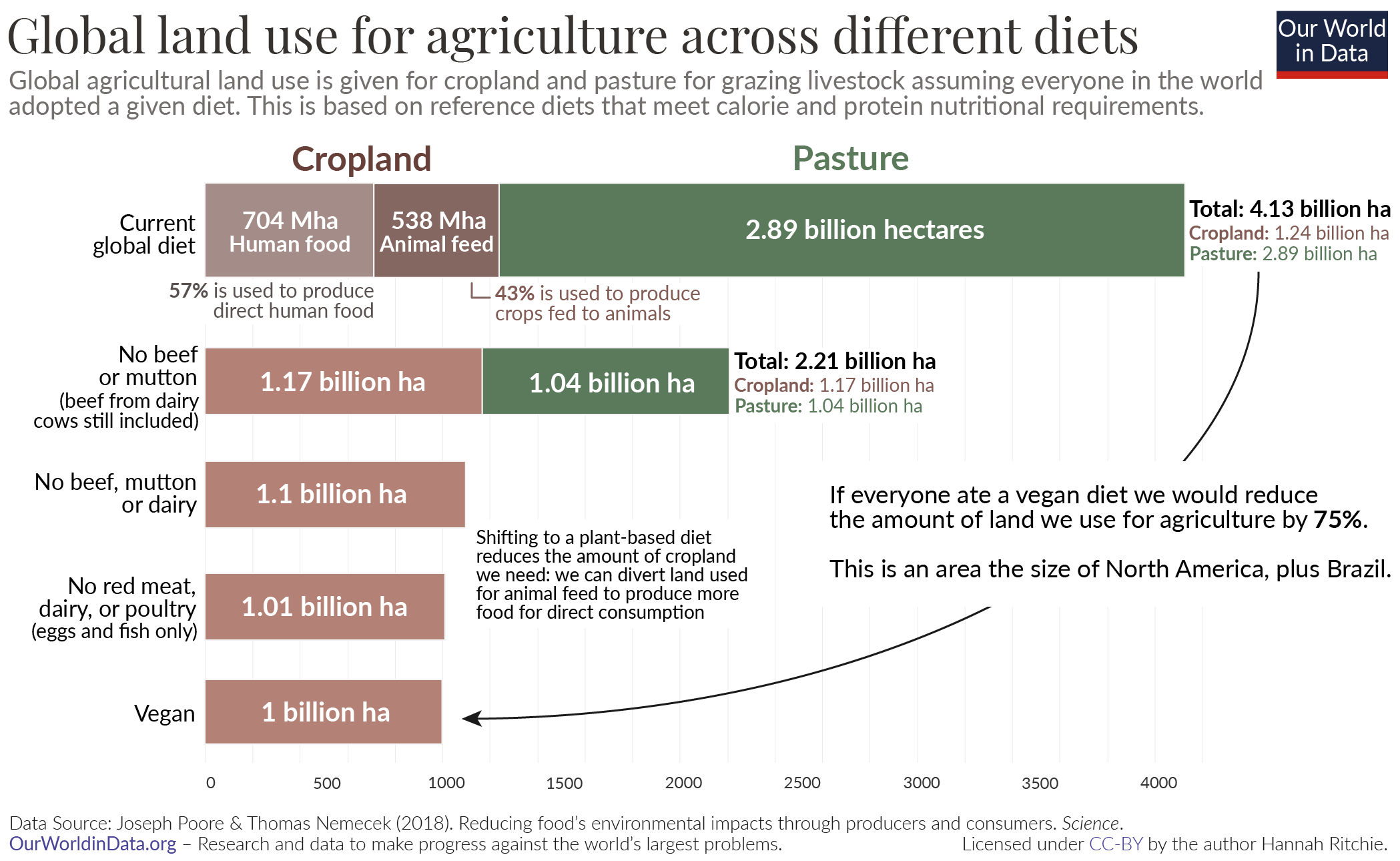
Global Agricultural Land Use
Research suggests that if everyone shifted to a plant-based diet, we would reduce global land use for agriculture by 75%. This large reduction of agricultural land use would be possible thanks to a reduction in land used for grazing and a smaller need for land to grow crops.
Our World in Data has the details.